When Was the Last Time Mount Fuji Erupted When Will Mount Fuji Erupt Again
Coordinates: 35°21′46.35″North 138°43′53.63″Eastward / 35.3628750°Northward 138.7315639°East / 35.3628750; 138.7315639 Historic eruptions of Mount Fuji ( 富士山の噴火史 , Fuji-san no funka-shi )
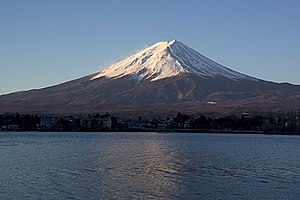
Mount Fuji is the tallest volcano in Nippon, and also the highest peak. The latest eruption of Mountain Fuji was in 1707, and it was triggered by an earthquake.[1] The mount as information technology appears now is the "New Fuji volcano", which began to erupt about 10,000 years ago. Nether the "New Fuji volcano" lies the "Sometime Fuji volcano", which was active between 100,000 years ago and 10,000 years ago, and the "Komitake volcano", which became active 700,000 years agone.
Prehistory [edit]
Komitake and Old Fuji [edit]
There has been volcanic activity in the vicinity of Mountain Fuji for several million years. The earliest geologically known volcano was Mount Komitake ( 小御岳火山 , small mountain volcano ) that became active 700,000 years ago. Another volcano to the s-east of Mount Fuji—known as Mount Ashitaka ( 愛鷹山 )—was as well highly agile throughout the period. The peak of Komitake is nigh ii,300 meters (7,500 ft) higher up sea-level on the north face up of Mountain Fuji (at the fifth station).
Komitake entered some other period of activity around 100,000 years ago. This created a new volcano known every bit Old Fuji ( 古富士 , kofuji , Old Fuji) that reached a meridian of 3,100 meters (ten,200 ft). Information technology created many explosive eruptions that threw out large amounts of scoria, volcanic ash and lava.
New Fuji [edit]
Following the Old Fuji period, there were about iv,000 years of inactivity, ending at around 5,000 years agone, when Mount Fuji became active over again; this period is known as New Fuji ( 新富士 , shinfuji ), and continues to the nowadays 24-hour interval. Eruptions of New Fuji showroom phenomena such equally lava flows, magma, scoria, volcanic ash, collapses and side eruptions, leading it to be chosen "a department store of eruptions". Ash from New Fuji is often black, and eruptions are new in terms of geological layers. Valuable data on the activity of Mountain Fuji is recorded in Japanese historical documents dating from the 8th century onwards. Information technology exhibits a range of representative eruptions.
The Gotemba mud flow [edit]
About 2,300 years ago the east face up of the volcano collapsed and lahars flowed down to the Gotemba surface area every bit far equally the Ashigara plain in the eastward and the Suruga bay across Mishima urban center in the south. This incident is at present called the Gotemba mud period ( 御殿場泥流 , Gotemba deiryū ). Liquid mud piled up over an area as wide as the metropolis surface area of Mishima.
Jōgan eruption [edit]
In 864 (the 6th yr of the Jōgan era) in that location was an eruption on the due north-eastward side of Mountain Fuji, which produced a bang-up amount of lava.
- 864 (Jōgan 6, fifth month): Mount Fuji erupted for 10 days, and it ejected from its top an immense quantity of cinders and ash which fell back to earth as far abroad equally the ocean at Edo bay. Many people perished and many homes were destroyed. The volcanic eruption began on the side of Fuji-san closest to Mount Asama, throwing cinders and ash as far away as Kai province.[2] Some of the lava filled upward a large lake Senoumi ( せの海 ) which existed at the time, dividing it into ii lakes, Saiko ( 西湖 ) and Shōjiko ( 精進湖 ). This is known as the Aokigahara lava ( 青木ヶ原溶岩 ), and at present is covered by the dumbo Aokigahara forest.
Hōei eruption [edit]
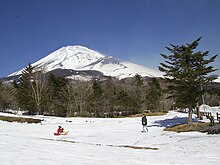
The Hoei Crater (on the height'due south right) was the location of the 1707 eruption.
The latest eruption, in 1707 (the quaternary year of the Hōei era), was known every bit the cracking Hōei eruption. Information technology followed several weeks later on the Great Hōei earthquake, an 8.7 on the Richter scale. The earthquake severely damaged the city of Osaka, but more than that, it created enough seismic activity to shrink the magma chamber 20 km deep in the inactive Mt. Fuji. Due to the compression of the magma sleeping room, basaltic lava rose from the lesser to the higher dacitic magma bedchamber at 8 km deep. The mixing of the two different types of magma caused a Plinian eruption to occur. Previous to the Hoei, another earthquake named Genroku had struck Nihon in 1703. The earthquake afflicted both Kanagawa and Shizuoka prefectures, and was measured every bit an viii.2 on the Richter Scale. The Genroku convulsion had a similar effect on Mt. Fuji equally Hoei but with less severity. It clamped the dike of the mountain at 8 km to the surface (where the dacitic magma resides), too as the basaltic chamber at 20 km deep. Many articles found a correlation between the two earthquakes, arriving at the conclusion that without either earthquake the Hoei eruption would not have happened.
- November 11, 1707 (Hōei 4, 14th day of the 10th month): The city of Osaka suffers tremendously because of a very fierce earthquake.[3]
- December 16, 1707 (Hōei 4, 23rd day of the 11th month): An eruption of Mountain Fuji; the cinders and ash fell in Izu, Kai, Sagami, and Musashi.[4] This eruption was remarkable, as it spread a vast amount of volcanic ash and scoria over a region as far as Edo (now Tokyo), which was almost 100 km (62.137 miles) away.
Records of eruption [edit]
Xvi eruptions of New Fuji have been recorded since 781. Many of the eruptions occurred in the Heian era, with twelve eruptions between 800 and 1083. Sometimes inactive periods between eruptions lasted for hundreds of years, as in the period between 1083 and 1511, when no eruptions were recorded for over 400 years. At present, there have been no eruptions since the Hoei eruption in 1707–1708, effectually 300 years agone.
Current eruptive danger [edit]
Scientists study the action of the magma rising by measuring COtwo emissions in the deeper parts of the volcano. Studies from before the Tohoku earthquake prove the CO2 emissions below v gCO2/m3/day, which is the detection limit. If the emissions rise above 5 gCOii/mthree/day so seismic activity is occurring and an eruption could possibly take place. According to a five-stage evolutionary model for the release of volcanic gas, Mt. Fuji would exist considered stage I. Magma is at a considerable 10 km (vi.2 mi) depth and no emissions of gases tin can be observed regularly.
Post-obit the 2011 Tōhoku convulsion and seismic sea wave, much attention was given to the volcanic reaction of Mount Fuji. Experts have constitute that the internal pressure of the Mount Fuji magma sleeping room has increased to an estimated 1.6 megapascals, raising speculation over the possibility of an eruption. The financial damage to Japan from a Fuji eruption is estimated at ¥two.5 trillion (nigh $25 billion).[5] [vi]
Run across as well [edit]
- Hōei eruption of Mount Fuji
- List of volcanoes in Japan
Notes [edit]
- ^ "Mt Fuji". www.volcanodiscovery.com . Retrieved 2019-ten-nineteen .
- ^ Titsingh, Isaac (1834). Nipon o daï itsi ran: ou Annales des empereurs du Japon. Oriental Translation Fund. p. 118.
- ^ Titsingh, Isaac (1834). Nipon o daï itsi ran: ou Annales des empereurs du Japon. Oriental Translation Fund. p. 415.
- ^ Shikuoka University page; encounter Japanese Wikipedia.
- ^ Blackstone, Samuel. "Experts Predict Nippon'southward Mountain Fuji Will Erupt Soon". Business Insider.
- ^ "2011 convulsion put pressure on Mt. Fuji - UPI.com". upi.com. Retrieved 2015-11-01 .
References [edit]
- Fujisan Sono Shizen no Subete ( 富士山 その自然のすべて ), "Mount Fuji - All Nigh Its Nature", written by Akira Suwa ( 諏訪彰 ) 1992 Dōbunshoin ( 同文書院 ) ISBN 4-8103-4047-iii
- Titsingh, Isaac. (1834). [Siyun-sai Rin-siyo/Hayashi Gahō, 1652], Nipon o daï itsi ran; ou, Annales des empereurs du Japon. Paris: Oriental Translation Fund of Great Great britain and Republic of ireland.
External links [edit]
- Fujisan "Fujisan (Mountain Fuji)". - Japan Meteorological Agency
- Fujisan (Mount Fuji) - Smithsonian Establishment: Global Volcanism Programme
Source: https://en.wikipedia.org/wiki/Historic_eruptions_of_Mount_Fuji
0 Response to "When Was the Last Time Mount Fuji Erupted When Will Mount Fuji Erupt Again"
Post a Comment