what is being done to address climate change
While nations wrangle over a new global treaty on climatic change, the question on many minds is: What happens adjacent?
Cardinal portions of the Kyoto Protocol are gear up to elapse at the end of 2012. Just many of the world's major greenhouse gas emitters take already set national targets to reduce emissions, and they're forging their own initiatives to encounter those goals.
Some are focusing on curbing deforestation and boosting renewable free energy sources. Several nations are experimenting with cap-and-merchandise plans: Regulators set mandatory limits on industrial emissions, only companies that exceed those "caps" tin can buy permits to emit from companies that have allowances to spare. In some cases, it's not clear that countries are doing much to meet their stated climate goals. What is clear is that the pledges currently on the table aren't legally binding, and they fall far short of what would exist required to stabilize the planet's temper.
Here'due south a look at what nations are doing:
Commonwealth of australia
Commonwealth of australia has ready a national goal of reducing greenhouse gas emissions past 5 percent beneath 2000 levels by 2020.
Australia didn't sign onto the Kyoto Protocol until 2007, after its Labor Party took control of government, reversing the previous administration's policy. Under the climate pact, Australia agreed to hold the growth in its greenhouse gas emissions to viii percent in a higher place 1990 levels for the 2008-2012 period. By and large, Commonwealth of australia has met those targets, by and large by reducing deforestation and state clearing.
In November 2011, Australian lawmakers approved an ambitious carbon trading programme — the world'southward largest outside of Europe. Nether the program, Australia's 500 worst polluters would be forced to pay a tax on every ton of carbon they emit starting in July 2012. By 2015, the nation plans to move to a full-on, market place-based carbon trading system. Commonwealth of australia says it plans to link its carbon marketplace to ane prepare in neighboring New Zealand. That might make information technology harder to dismantle the market if conservatives win back command of Australia's regime in 2013.
Brazil
Brazil is aiming to reduce its emissions to 1994 levels and cutting deforestation past 80 percentage from historic highs by 2020.
Brazil's National Climate Change Programme is focused on expanding renewable electric free energy sources and beefing up the use of biofuels in the transportation industry. The country is also focusing heavily on reducing deforestation rates: Information technology'south hoping to eliminate illegal deforestation and bring the net loss of forest coverage to nada by 2015.
But a proposal to loosen Brazil's deforestation rules is currently making its way through the legislature. If enacted, critics say the changes could create more opportunities for logging.
Canada
When Canada signed onto the Kyoto Protocol, information technology committed to reducing its greenhouse gas emissions past 6 percent below 1990 levels. It later proposed a new, less ambitious goal to reduce emissions by 17 percent from 2005 levels by 2020, a pledge that matches the U.S.
Canada did little to try to meet its obligations nether the Kyoto Protocol. Indeed, today, the country's emissions are 17 percent above 1990 levels — in big part because of emissions tied to the muddy business of extracting oil from Alberta'due south tar sands.
According to a Canadian government report released in mid-2011, emissions from tar sands will more than than cancel out the progress that Canada has made in shifting its electricity generation from coal to natural gas. By 2020, the study projects that Canada will fall well brusque of its stated emission-reduction targets.
China
Mainland china hasn't made any pledges to reduce its carbon emissions.Equally its economy grows, emissions volition increment. But China has promised to become at least 40 pct more than energy efficient by 2015.
People's republic of china is the world'south biggest producer and consumer of coal — and the No. 1 emitter of greenhouse gases and the 2nd-largest consumer of energy. Merely information technology'due south also a developing nation — which means that, like other developing nations, it isn't required to lower its emissions under the Kyoto Protocol.
Still, People's republic of china'due south coal resources aren't space, and as the state finds itself importing more of the fossil fuel to power its growth, it is also aggressively pursuing renewable free energy sources. Chinese leaders have said they want not-fossil fuels to business relationship for 15 percentage of the nation's energy sources by 2020. Under a law passed in 2005, Chinese power filigree companies are required to buy a sure percentage of their total power supply from renewable free energy sources. And China provides extensive subsidies to its clean free energy sector — like the U.South., it hopes that green tech jobs can fuel hereafter growth. Withal, many analysts warn that weaning China off coal won't be easy.
The country has also committed to boosting its forest cover, and it is experimenting with a carbon trading plan: Lawmakers recently canonical a pilot plan in vii provinces and cities.
European Union
The EU and its 27 fellow member states have pledged to reduce emissions by 20 pct below 1990 levels by 2020. The European union has said information technology would bump this commitment upwards to 30 percentage if other developed countries sign up for similar commitments.
Under the Kyoto Protocol, the then-fifteen European union member states signed on to reduce emissions by eight percent below 1990 levels by 2012. To come across that goal, in 2005 the EU launched the biggest carbon trading market in the earth. Today, all 27 member states are required to participate, plus Iceland, Liechtenstein and Kingdom of norway. Major factories and power plants in the European union are granted permits for how much carbon they tin can emit. Companies that emit less carbon than their allotted amount tin sell their actress carbon credits to firms that exceed their emissions limit.
Starting in January, all airlines with flights that have off or land in Europe volition be required to buy carbon permits to starting time emissions from their flights. That requirement has sparked objections and legal challenges from several nations that argue information technology violates international law.
India
Republic of india, like China, also won't commit to reducing its carbon emissions — proverb that would hurt efforts to bring millions of its citizens out of poverty. Only information technology has agreed to increment its energy efficiency by twenty percent by 2015.
India is the world'due south No. 3 emitter of greenhouse gases, but because it's a developing nation, it isn't required to cut emissions under the Kyoto Protocol. That said, Bharat is an active participant in the Clean Development Mechanism — a carbon offset plan gear up nether the Kyoto Protocol. Basically, the CDM lets developing nations like Bharat earn credits for implementing emission-reducing projects. Bharat tin then sell those credits to an industrialized nation, which can count them toward its overall emissions-reduction commitment. India has hundreds of CDM projects; almost half of them focus on wind power and biomass.
India has set an ambitious goal of getting 20 gigawatts of solar ability online past 2022. A gigawatt of electricity is enough to power a small-scale metropolis. In 2010, the state started levying a carbon taxation on coal to help subsidize renewable energy projects.
Indonesia
Indonesia has pledged to cut emissions by 26 per centum by 2020 from today'south levels.
Indonesia is domicile to vast swaths of tropical forests, which suck up atmospheric carbon. Only those forests are being logged at an alarming charge per unit — and that's releasing huge amounts of carbon into the atmosphere. Under a deal with Norway that went into effect in May 2011, Indonesia agreed to implement a two-year moratorium on new concessions for immigration forests in commutation for $1 billion in support for its wood conservation efforts.
But many observers question Indonesia'due south delivery to preventing deforestation, given that the country'southward current economic boom has been largely fueled by extraction of its natural resources. Allegations that Forestry Ministry building officials have lined their political war chests with funds raised by selling off logging rights haven't done much to bolster confidence.
Japan
Nippon has pledged to reduce its emissions by 25 percent below 1990 levels by 2020.
The world'southward No. 5 greenhouse gas producer, Japan committed to reducing its emissions by 6 pct below their 1990 levels under the Kyoto Protocol, and it was largely on runway to meet that goal. In 2010, it launched a cap-and-trade plan aimed at forcing some one,300 major businesses — including large role buildings, public buildings and schools — in the Tokyo metropolitan region to reduce their emissions.
However, the Fukushima nuclear disaster threw Japan a fastball. The nation relied on nuclear power for near a third of its electricity, but in the wake of the March 2011 accident, the vast majority of its reactors accept gone offline. The lost output forced Nihon to plant energy-reducing measures and, in the short term, to rely more heavily on fossil fuel-burning power utilities — which boosted its emissions in 2011. With the Japanese public now wary about nuclear energy, the nation'due south leaders are trying to find a new mode forward.
Russia
Russian federation has pledged to reduce its emissions by at least xv pct from 1990 levels — a twelvemonth when the Soviet Union was even so in existence, and emissions from heavy industry, mostly related to the war machine, were sky high.
When Russia ratified the Kyoto Protocol in 2004, it pledged to hold its greenhouse gas emissions at or below 1990 levels. After the Soviet Wedlock collapsed, Russian federation'due south emissions did, also. So the country hasn't had to do much to meet its Kyoto pledges.
Indeed, Russia has long been known as a land with petty regard for environmental concerns, and information technology is still largely dependent on many heavy industries that are considered major polluters. Despite Russian ratification of the climate pact, for a long time the country'due south leaders connected to question the human role in climate change.
In 2009, the Russian regime quietly reversed that position, adopting a new climate doctrine that seemed to accept human contribution to global warming. The aforementioned year, the country pledged to reduce its emissions by at to the lowest degree xv pct from 1990. Yet, this pledge all the same doesn't crave any action on Russia's role: By some estimates, the country'southward emissions remain more than 30 percentage below 1990 highs. Though Russia has unveiled energy-efficiency goals, analysts phone call the country's climate policies "a black hole."
South Africa
South Africa expects its emissions to peak between 2020 and 2025, and so remain flat for a decade before dropping off. Past 2020, South Africa aims for emissions to top out at levels 34 pct lower than if the state were to take no deportment.
South Africa is highly dependent on coal — about xc percent of its electricity comes from burning the fossil fuel — and it'southward a major contributor to greenhouse gas emissions in Africa. The nation is slowly studying cleaner energy options and more energy-efficient alternatives. But to motility forrard with any emission reductions, Due south Africa says it'due south going to need funding and support from industrialized nations.
South Africa'south renewable free energy initiative aims to make make clean power account for nearly nine percentage of the nation's energy mix by 2030. Merely that project is just getting off the ground: Structure on the first few dozen projects, mostly wind and solar power plants, won't begin until later mid-2012 at the earliest.
The country says information technology'southward committed to making nuclear power — which currently supplies nigh 5 percent of its electricity — a much bigger office of its energy mix in the future. But a shortage of funding may delay those plans.
Us
The U.Due south. pledged toreduce emissions by 17 percent past 2020, just that promise was contingent on Congress passing an aggressive cap-and-merchandise bill. Instead, the nib ended upward in the trash, and the U.S. hasn't made it articulate how it will meet its emission goals.
The U.S. has taken some actions at the federal level to curb emissions, including new nationwide fuel-efficiency standards for cars and light trucks. Individual states as well have laws designed to lower their emissions in the coming decades. California has the well-nigh ambitious plan: Starting in 2013, the state will cap greenhouse gas emissions from factories and power plants, and, eventually, emissions from vehicles.
But even with all those state and federal actions taken together, the World Resources Found figures that the U.South. can't achieve a 17 percent reduction in emissions by 2020. New federal laws — for example, i that puts a revenue enhancement on carbon emissions — would need to fill the gap, and prospects for that aren't skillful.
While nations wrangle over a new global treaty on climatic change, the question on many minds is: What happens side by side?
Fundamental portions of the Kyoto Protocol are set to expire at the end of 2012. Just many of the world's major greenhouse gas emitters have already gear up national targets to reduce emissions, and they're forging their own initiatives to meet those goals.
Some are focusing on curbing deforestation and boosting renewable energy sources. Several nations are experimenting with cap-and-trade plans: Regulators set mandatory limits on industrial emissions, only companies that exceed those "caps" can buy permits to emit from companies that accept allowances to spare. In some cases, it'south not articulate that countries are doing much to meet their stated climate goals. What is articulate is that the pledges currently on the table aren't legally binding, and they autumn far short of what would be required to stabilize the planet'due south atmosphere.
Here's a look at what nations are doing:
Australia
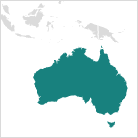
Commonwealth of australia has set a national goal of reducing greenhouse gas emissions by 5 per centum below 2000 levels by 2020.
Australia didn't sign onto the Kyoto Protocol until 2007, afterward its Labor Political party took command of regime, reversing the previous administration'due south policy. Under the climate pact, Australia agreed to concord the growth in its greenhouse gas emissions to eight percentage above 1990 levels for the 2008-2012 menstruum. More often than not, Australia has met those targets, mostly past reducing deforestation and land clearing.
In November 2011, Australian lawmakers approved an ambitious carbon trading plan — the globe's largest outside of Europe. Under the plan, Australia's 500 worst polluters would exist forced to pay a tax on every ton of carbon they emit starting in July 2012. By 2015, the nation plans to move to a total-on, market-based carbon trading organisation. Commonwealth of australia says it plans to link its carbon market to 1 set in neighboring New Zealand. That might make information technology harder to dismantle the market if conservatives win back control of Commonwealth of australia's government in 2013.
Brazil
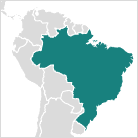
Brazil is aiming to reduce its emissions to 1994 levels and cut deforestation by 80 percent from celebrated highs by 2020.
Brazil'due south National Climatic change Plan is focused on expanding renewable electric free energy sources and beefing up the utilize of biofuels in the transportation industry. The country is also focusing heavily on reducing deforestation rates: Information technology'south hoping to eliminate illegal deforestation and bring the net loss of forest coverage to nada by 2015.
Merely a proposal to loosen Brazil'southward deforestation rules is currently making its way through the legislature. If enacted, critics say the changes could create more opportunities for logging.
Canada
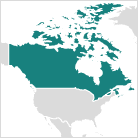
When Canada signed onto the Kyoto Protocol, it committed to reducing its greenhouse gas emissions past 6 percent below 1990 levels. Information technology afterward proposed a new, less ambitious goal to reduce emissions by 17 pct from 2005 levels by 2020, a pledge that matches the U.S.
Canada did little to try to meet its obligations under the Kyoto Protocol. Indeed, today, the country'due south emissions are 17 percent above 1990 levels — in large part considering of emissions tied to the dirty business of extracting oil from Alberta'southward tar sands.
According to a Canadian authorities report released in mid-2011, emissions from tar sands will more than than cancel out the progress that Canada has made in shifting its electricity generation from coal to natural gas. By 2020, the report projects that Canada will fall well short of its stated emission-reduction targets.
Prc
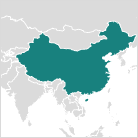
China hasn't made any pledges to reduce its carbon emissions. As its economy grows, emissions will increase. Merely China has promised to become at to the lowest degree 40 pct more energy efficient by 2015.
Red china is the globe's biggest producer and consumer of coal — and the No. one emitter of greenhouse gases and the second-largest consumer of energy. But it's also a developing nation — which means that, like other developing nations, it isn't required to lower its emissions under the Kyoto Protocol.
Still, China's coal resources aren't infinite, and as the country finds itself importing more of the fossil fuel to power its growth, it is too aggressively pursuing renewable energy sources. Chinese leaders have said they want not-fossil fuels to account for 15 percent of the nation's free energy sources by 2020. Nether a police force passed in 2005, Chinese ability grid companies are required to buy a sure percentage of their total ability supply from renewable free energy sources. And Red china provides extensive subsidies to its clean free energy sector — similar the U.S., it hopes that green tech jobs can fuel hereafter growth. Fifty-fifty so, many analysts warn that weaning China off coal won't be easy.
The country has also committed to boosting its forest cover, and information technology is experimenting with a carbon trading program: Lawmakers recently approved a pilot program in seven provinces and cities.
European union
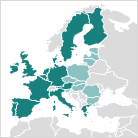
The EU and its 27 member states have pledged to reduce emissions by twenty percent beneath 1990 levels by 2020. The European union has said it would bump this commitment upwards to 30 percentage if other developed countries sign up for like commitments.
Under the Kyoto Protocol, the then-xv European union member states signed on to reduce emissions by 8 pct below 1990 levels by 2012. To meet that goal, in 2005 the EU launched the biggest carbon trading market in the world. Today, all 27 fellow member states are required to participate, plus Republic of iceland, Principality of liechtenstein and Kingdom of norway. Major factories and ability plants in the Eu are granted permits for how much carbon they tin emit. Companies that emit less carbon than their allotted corporeality can sell their actress carbon credits to firms that exceed their emissions limit.
Starting in Jan, all airlines with flights that take off or land in Europe will exist required to buy carbon permits to commencement emissions from their flights. That requirement has sparked objections and legal challenges from several nations that argue it violates international law.
Bharat

India, like China, also won't commit to reducing its carbon emissions — saying that would injure efforts to bring millions of its citizens out of poverty. But it has agreed to increase its energy efficiency past twenty percent by 2015.
India is the globe'south No. 3 emitter of greenhouse gases, just because it's a developing nation, information technology isn't required to cut emissions nether the Kyoto Protocol. That said, India is an active participant in the Make clean Evolution Mechanism — a carbon offset plan set nether the Kyoto Protocol. Basically, the CDM lets developing nations like Bharat earn credits for implementing emission-reducing projects. India can then sell those credits to an industrialized nation, which can count them toward its overall emissions-reduction commitment. India has hundreds of CDM projects; almost half of them focus on wind power and biomass.
Bharat has set up an aggressive goal of getting 20 gigawatts of solar power online by 2022. A gigawatt of electricity is enough to power a small city. In 2010, the country started levying a carbon tax on coal to aid subsidize renewable energy projects.
Indonesia
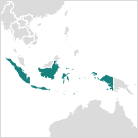
Indonesia has pledged to cut emissions past 26 pct past 2020 from today's levels.
Indonesia is home to vast swaths of tropical forests, which suck upwardly atmospheric carbon. But those forests are being logged at an alarming rate — and that's releasing huge amounts of carbon into the atmosphere. Under a bargain with Norway that went into effect in May 2011, Indonesia agreed to implement a two-year moratorium on new concessions for clearing forests in commutation for $i billion in support for its forest conservation efforts.
But many observers question Indonesia's commitment to preventing deforestation, given that the state'due south current economic boom has been largely fueled past extraction of its natural resource. Allegations that Forestry Ministry officials have lined their political war chests with funds raised past selling off logging rights haven't done much to bolster confidence.
Japan
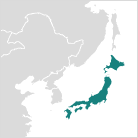
Japan has pledged to reduce its emissions by 25 percent below 1990 levels past 2020.
The earth's No. 5 greenhouse gas producer, Japan committed to reducing its emissions by six percent beneath their 1990 levels under the Kyoto Protocol, and it was largely on track to meet that goal. In 2010, information technology launched a cap-and-merchandise plan aimed at forcing some 1,300 major businesses — including large part buildings, public buildings and schools — in the Tokyo metropolitan region to reduce their emissions.
Still, the Fukushima nuclear disaster threw Japan a fastball. The nation relied on nuclear ability for near a third of its electricity, simply in the wake of the March 2011 accident, the vast majority of its reactors have gone offline. The lost output forced Japan to institute energy-reducing measures and, in the curt term, to rely more than heavily on fossil fuel-burning power utilities — which boosted its emissions in 2011. With the Japanese public at present wary about nuclear energy, the nation's leaders are trying to find a new way forward.
Russia
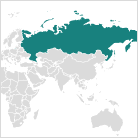
Russia has pledged to reduce its emissions past at least fifteen percent from 1990 levels — a yr when the Soviet Marriage was nevertheless in existence, and emissions from heavy industry, mostly related to the military, were heaven high.
When Russia ratified the Kyoto Protocol in 2004, it pledged to hold its greenhouse gas emissions at or below 1990 levels. Later on the Soviet Union collapsed, Russian federation's emissions did, as well. Then the country hasn't had to do much to run across its Kyoto pledges.
Indeed, Russia has long been known as a country with little regard for environmental concerns, and it is still largely dependent on many heavy industries that are considered major polluters. Despite Russian ratification of the climate pact, for a long fourth dimension the state's leaders continued to question the human being role in climate alter.
In 2009, the Russian government quietly reversed that position, adopting a new climate doctrine that seemed to accept human contribution to global warming. The same twelvemonth, the country pledged to reduce its emissions past at least xv percent from 1990. Nevertheless, this pledge even so doesn't require any action on Russia'southward part: By some estimates, the country's emissions remain more 30 percent below 1990 highs. Though Russia has unveiled energy-efficiency goals, analysts phone call the land's climate policies "a black hole."
Southward Africa
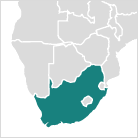
S Africa expects its emissions to peak between 2020 and 2025, and so remain flat for a decade before dropping off. By 2020, South Africa aims for emissions to meridian out at levels 34 per centum lower than if the land were to have no actions.
South Africa is highly dependent on coal — well-nigh 90 percent of its electricity comes from called-for the fossil fuel — and it's a major contributor to greenhouse gas emissions in Africa. The nation is slowly studying cleaner energy options and more energy-efficient alternatives. But to move frontward with whatsoever emission reductions, South Africa says it's going to need funding and support from industrialized nations.
Due south Africa'due south renewable energy initiative aims to clean power account for nearly nine per centum of the nation'due south free energy mix past 2030. Simply that project is just getting off the ground: Construction on the first few dozen projects, mostly wind and solar power plants, won't begin until after mid-2012 at the primeval.
The country says it'southward committed to making nuclear ability — which currently supplies about five percent of its electricity — a much bigger part of its free energy mix in the future. But a shortage of funding may filibuster those plans.
United States
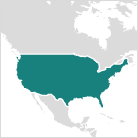
The U.S. pledged to reduce emissions by 17 percent past 2020, but that promise was contingent on Congress passing an ambitious cap-and-trade bill. Instead, the bill ended up in the trash, and the U.S. hasn't fabricated it clear how information technology volition encounter its emission goals.
The U.South. has taken some actions at the federal level to curb emissions, including new nationwide fuel-efficiency standards for cars and low-cal trucks. Individual states also have laws designed to lower their emissions in the coming decades. California has the nigh ambitious program: Starting in 2013, the state will cap greenhouse gas emissions from factories and power plants, and, eventually, emissions from vehicles.
But even with all those state and federal actions taken together, the Earth Resources Institute figures that the U.S. can't accomplish a 17 percent reduction in emissions by 2020. New federal laws — for case, one that puts a tax on carbon emissions — would need to fill the gap, and prospects for that aren't good.
Source: https://www.npr.org/2011/12/07/143302823/what-countries-are-doing-to-tackle-climate-change
0 Response to "what is being done to address climate change"
Post a Comment